Tuesday, 6 September 2011

Connections

Philosophy and Exploration

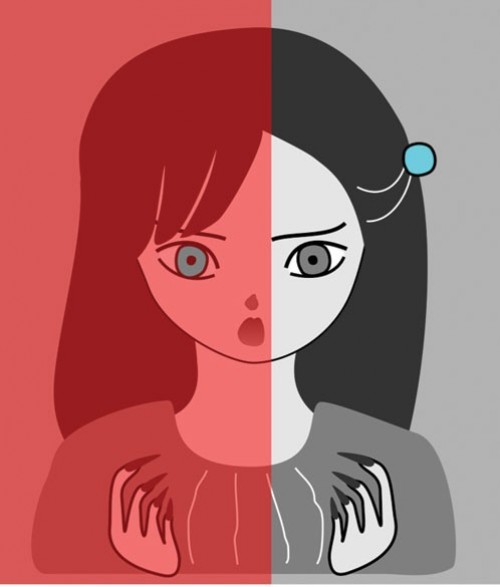
I had a psychology lecture today on perception. We learned how everything we see and experience is an approximation of our reality. Mostly we focused on colour.

It reminded me of Ben's previous lecture where he told us that shapes have a colour. I also thought of the chapter of the Design in Context subject about colour.

What strikes me about this is how these different subjects overlap and tell us something similar about the world. Everything around us is related and connected.  I don't know if this is because everything in the world has a similar 'code' behind it, or it comes about as result of a brain working to connect ideas. I suspect it is a bit of both.

The picture below is from the psychology lecture. Would you believe both eye's are the same colour?
Monday, 5 September 2011

Arrays and mousePressed

Experiments

In my final design I'd like to include multiple objects. Ben and Steven showed us the power of Arrays to not only create objects en masse, but apply properties to them all as well.  The trick is to use loops that address every instance (or locker) of the array and apply a value to them.

I created an example to show this at work that i'd like to implement it into my final design. It resembles those screensaver star-fields of old. If you hold the mouse button now mousePressed is activated creating a 'warp' effect

The difficult part was understanding how to individually animate each star. The method was to add a percentage of the distance between the stars and the centre of the screen to each star every time draw is run.

These projects really shows me how simple code can make something quite beautiful.

Star-field - Open Processing Link

Sinuous

Research

Found another great interaction. This one, a game, sees you playing the role of a humble sperm.

Ok, it's possibly not a sperm, but it's tons of fun. You have to race past red dots coming from the left of the screen. I suppose it must use arrays to produce the them.

It's interaction stems from the need to avoid the dots. Pickups produce other interactive effects such as the ability to push the dots away or destroy them with a shield.

I wouldn't mind taking some inspiration. It does a good job of showing some creative ways that onscreen elements can interact.

Sinuous - Link to game

Zune Journey

Research

I found this great advertisement at http://www.zunejourney.net/. You have to click and it the objects and scenery that float past move towards your mouse to create the illusion that you are controlling the direction of your journey. It's fun, has pumping music and looks great.

On the other hand, it's not particularly interactive, and it suffers for it. The visuals and music might keep you glued for a little while, but the illusion is lost pretty quickly.

Still,  it give me an idea for what I would like to do for my own work. What if by going in a certain direction creates a dynamic change on the objects. When you change direction more dynamic changes occur based on the previous. It would produce a varied result every time and the user interaction would be abstracted.


mousePressed() and Double Clicking

Experiments

This first experiment is an attempt to take mousePressed() and take it to its next logical conclusion.

Double Clicking!

This experiment was to show how double clicking might work. I used the frameCount variable as a type of clock. If the user clicks twice within three frames of draw() the circle changes colour, but a single click will only produce a 'selection' like effect.

And it works. I wanted it to simulate the feel of clicking or double clicking a file on a computer. However, it does seems to have some issues. For one the double click should never appear without the selection effect, and it does. Secondly, when this does occur, the colour change can only be removed by clicking on the circle again. When things don't perform as expected, this can be a problem for the user experience.

If I get a chance I'd like to rewrite the code of this example in a later blog post. Spending a long time overcoming issues  really made me appreciate the importance of using comments and naming variables.

Ben told us that coding is not maths. I must admit that I didn't quite believe him. However, I think I'm starting to realise that he might have been right. Perhaps coding is about translating the language of imagination, into the language of computers.

Spotlight - Open Processing Link

Sunday, 4 September 2011

Outside of the Box

Philosophy and Exploration

A couple of days ago I sent Steven an email asking him how I could improve this blog.

And he gave me some really good advice.

He told me that the blog needed to contain research images, precedents plus critical analysis and experimentation. It is to be a sandbox that provides an insight into my thought process. So I'm going to work to have multiple posts addressing these elements of the assignment.

However he also stressed the point that the key to doing well is thinking outside of the box. And that means coming up with ideas that surprise and do things a bit differently. This is probably the most difficult thing to do well, but it fits unexpectedly well into the ideas of variation and interaction. Perhaps part of the purpose of this project is to help us understand that.

On a more practical level this means I'll try to have some creative ideas for this blog. My first idea is to separate these posts into sections such as philosophy and exploration, research and experimentation. I'll also highlight words that I think are important.

The outside man

Friday, 2 September 2011

Interaction

Philosophy and Exploration

I wanted to explore what the essence of interaction is.

My first thought was: What happens if you take interaction away? What are we left with? No matter how much we give to the world we would never get anything back in return. We could never be anything more then observers like a deist god. I think this suggests that a major component of interaction is purpose.

Next I thought of interaction as a conversation as the assignment brief suggests. When speaking to someone we have a certain level of control over the conversation. However it is the variation in response that makes the conversation interesting. In this case variability is shown to be a component of interaction.

I hope to produce a design that focuses on providing a purpose to the user. This means that they should have a reason to continue interacting with it for more than 20 seconds. Its response should also be variable to the user's actions.

Future Flickrites?